Bitcoin Halving: Could 2026 Be Different
Every four years, the cryptocurrency market enters a period of anticipation known as the Bitcoin halving cycle. Traders, investors, and analysts closely monitor this event because historically it has been linked to some of the largest bull markets in crypto history. Previous halvings helped fuel major price rallies that pushed Bitcoin from double digits into the thousands, and later from thousands into the tens of thousands.
The crypto market has matured significantly over the last decade. Institutional investors are now heavily involved, spot Bitcoin ETFs have opened the market to traditional finance, and AI-powered trading systems can react to market conditions faster than human traders ever could. These factors could dramatically reshape the way the halving cycle behaves moving forward.
The question many investors are asking is simple: will the next cycle repeat history, or are we entering an entirely new phase for Bitcoin?
What the Bitcoin Halving Is
Bitcoin was designed with a fixed supply cap of 21 million coins. Unlike traditional fiat currencies that can be printed indefinitely, Bitcoin’s supply issuance decreases over time through a mechanism called the halving.
Roughly every four years, the reward miners receive for validating transactions is cut in half. This process slows the creation of new Bitcoin entering circulation and increases scarcity over time.
When Bitcoin first launched in 2009, miners earned 50 BTC per block. The first halving in 2012 reduced this reward to 25 BTC. The second halving in 2016 lowered it to 12.5 BTC, while the third in 2020 reduced rewards to 6.25 BTC. The most recent halving in 2024 cut rewards again to 3.125 BTC per block.
The theory behind the halving is straightforward economics. If demand remains steady or increases while the supply of new Bitcoin decreases, the price should rise over time. This built-in scarcity model is one of the main reasons Bitcoin is often compared to gold.
Historically, halvings have acted as catalysts for major bull markets. Investors begin accumulating months before the event, expecting reduced supply to drive prices higher in the following year.
But while the halving itself is predictable, market reactions are not guaranteed.
Historical Price Action
Looking at previous cycles helps explain why the halving attracts so much attention.
The 2012 Halving
Bitcoin’s first halving occurred in November 2012 when the asset was still relatively unknown outside tech communities and early adopters. Before the halving, Bitcoin traded around $12.
Over the following year, the market experienced one of its first explosive rallies, eventually reaching over $1,000 in late 2013. While other factors contributed to the rally, the reduction in supply became a central narrative behind Bitcoin’s growing value.
The 2016 Halving
By 2016, Bitcoin had gained more mainstream recognition. Exchanges were improving, retail participation increased, and media coverage expanded significantly.
Bitcoin traded near $650 around the time of the second halving. In the following 18 months, the market entered another massive bull run that peaked near $20,000 in December 2017.
This cycle introduced millions of new investors to crypto and sparked the ICO boom. Many traders began believing the four-year halving cycle had become a reliable pattern.
The 2020 Halving
The third halving occurred during a completely different economic environment. Governments around the world injected massive liquidity into markets following the COVID-19 pandemic, and investors searched for alternative assets.
Bitcoin traded around $8,000 to $9,000 during the 2020 halving before climbing to nearly $69,000 in 2021.
This cycle also marked the arrival of corporate and institutional interest. Companies began adding Bitcoin to their balance sheets, while major financial firms started offering crypto-related products to clients.
For many investors, this cycle reinforced the belief that halvings directly trigger major bull markets.
Yet there is an important detail often overlooked: each cycle has produced smaller percentage gains than the previous one. As Bitcoin grows into a larger asset class, repeating the extreme returns of earlier years becomes increasingly difficult.
Why Institutions Matter Now
One of the biggest differences heading into 2026 is the level of institutional involvement in the crypto market.
In earlier cycles, Bitcoin was largely driven by retail investors and speculative traders. Today, the landscape is very different.
Spot Bitcoin ETFs have made it easier than ever for traditional investors to gain exposure without directly holding crypto. Pension funds, hedge funds, banks, and wealth management firms can now access Bitcoin through regulated financial products.
This changes the dynamics of the market in several ways.
Reduced Volatility
Institutional investors typically operate with longer investment horizons than retail traders. Instead of chasing short-term hype, many institutions view Bitcoin as a strategic asset allocation similar to gold or tech stocks.
This could reduce some of the extreme volatility seen in previous cycles.
Increased Liquidity
Large financial firms bring significant capital into the market. Higher liquidity can make Bitcoin more stable and more attractive to additional institutional participants.
At the same time, this increased liquidity may also weaken the dramatic supply shock effect that halvings once created.
AI and Algorithmic Trading
Another major factor is the rise of AI-driven trading systems.
Crypto markets are now heavily influenced by algorithms capable of analyzing price action, sentiment, macroeconomic data, and on-chain activity in real time. These systems can react instantly to changing conditions and often identify patterns before retail traders notice them.
In previous cycles, much of the market behavior was driven by emotion and speculation. AI trading models may create a more efficient market where predictable events like halvings are priced in earlier than before.
This means the traditional post-halving rally could arrive sooner, become weaker, or behave differently altogether.
Government and Regulatory Influence
Regulation also plays a much larger role today than in earlier cycles.
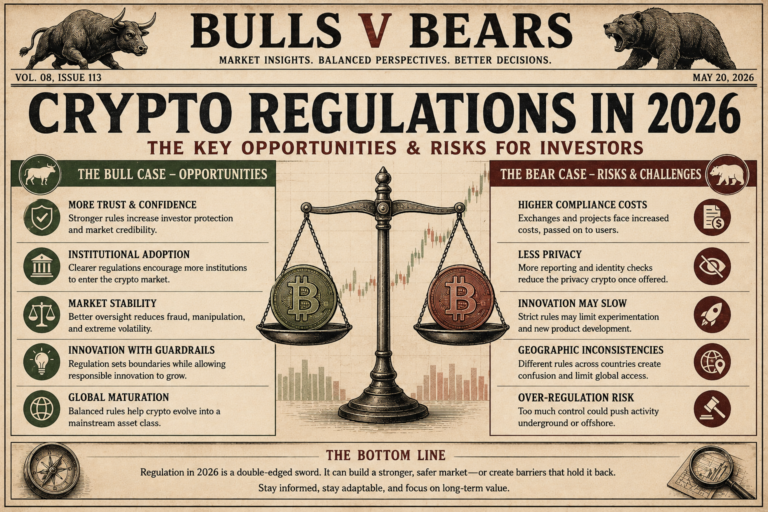
Governments worldwide are paying closer attention to cryptocurrency taxation, stablecoins, anti-money laundering rules, and exchange compliance. Institutional investors generally require regulatory clarity before entering markets at scale.
Positive regulation could strengthen Bitcoin’s legitimacy, while restrictive policies could slow growth or increase uncertainty.
Risks to the Cycle Theory
Many investors assume Bitcoin’s historical cycle will continue indefinitely, but there are several risks to that assumption.
Markets Learn Over Time
The more widely known a pattern becomes, the less effective it often becomes. Traders now anticipate halvings years in advance, meaning much of the expected price movement could already be reflected in the market before the event occurs.
Macroeconomic Conditions Matter
Bitcoin no longer trades in isolation. Interest rates, inflation, recession fears, and global liquidity all influence crypto markets.
If central banks maintain tighter monetary policies in 2026, risk assets including Bitcoin could face pressure regardless of the halving.
Diminishing Returns
Each halving cycle has produced lower percentage gains than the previous one. Bitcoin’s market capitalization is now significantly larger than it was during earlier rallies.
Moving a trillion-dollar asset requires far more capital than moving a billion-dollar asset.
Competition From Other Assets
Bitcoin remains dominant, but competition within crypto continues to grow. Ethereum, AI-related blockchain projects, tokenized assets, and new financial technologies are all competing for investor attention and capital.
Future cycles may see money spread across multiple sectors rather than concentrating heavily into Bitcoin alone.
2026 Predictions
Predicting Bitcoin’s future price is always difficult, but several possible scenarios could shape the market in 2026.
Scenario One: A Traditional Bull Market
The most bullish case is that the halving cycle continues largely as expected. Reduced supply combined with strong ETF inflows and institutional adoption could push Bitcoin to new all-time highs.
Under this scenario, retail investors may once again enter the market aggressively as media coverage increases and momentum builds.
Scenario Two: A Slower, More Mature Market
A more realistic possibility is that Bitcoin experiences a steadier and less explosive rally than previous cycles.
Institutional involvement could create a more stable market structure with fewer dramatic boom-and-bust swings. Instead of parabolic moves, Bitcoin may gradually trend upward over longer periods.
This would resemble traditional financial markets more than the wild crypto cycles of the past.
Scenario Three: Cycle Failure
There is also the possibility that the halving cycle weakens significantly or fails altogether.
If global economic conditions deteriorate, regulations tighten, or institutional demand slows, Bitcoin could struggle to replicate previous post-halving rallies.
While long-term believers would likely continue accumulating, short-term traders expecting guaranteed gains could be disappointed
Bitcoin’s halving remains one of the most important events in the cryptocurrency market, but 2026 could represent a turning point in how these cycles behave.
Previous halvings occurred in a market dominated by retail speculation and relatively low institutional involvement. Today, Bitcoin exists within a far more complex financial environment shaped by ETFs, professional trading firms, AI-driven algorithms, and global regulation.
The traditional four-year cycle may still influence price action, but investors should avoid assuming history will repeat perfectly. Markets evolve, and Bitcoin is no longer the niche asset it once was.
Whether 2026 brings another explosive rally or a more mature market structure, one thing remains clear: Bitcoin continues to move closer toward becoming a globally recognized financial asset class rather than simply a speculative experim